Minsky IPE
Products that help expert users work with complex information, evidence, and connected entities — with clear hypotheses about trust, control, and decision quality.
See detailsDesigning for US Department of War (DoW) Intelligence Analysts requires moving past standard consumer UX paradigms. These users operate in high-stakes, hyper-secure, and structurally rigid environments.
Turning Constraints into Opportunities
Stub intro for this section. Replace with final copy that frames the constraint-to-opportunity pairs below.
Isolated Environments
Security requirements and disconnected networks limit access to cloud-based AI, keeping sensitive intelligence workflows within tightly controlled environments.
AI at the Edge
Bring AI capabilities directly into secure DoD environments through on-premises infrastructure and locally deployed models, enabling AI-assisted intelligence production without compromising data control.
Established Workflows
Introducing standalone applications adds friction to established workflows, requiring analysts to switch tools, learn new interfaces, and disrupt familiar processes.
Native Integration
Embed AI assistance directly into Microsoft Office, bringing analytical capabilities into the tools analysts already use and reducing the friction between research, analysis, and production.
Fragmented Intelligence
Intelligence requirements, source material, analytical products, and review processes are often distributed across disconnected tools and teams, making it harder to maintain context and trace evidence throughout the lifecycle.
A Connected Lifecycle
Create a connected intelligence production environment that links requirements, sources, claims, feedback, and deliverables, providing the context needed for AI-assisted analysis, validation, and collaboration.
Intelligence Life Cycle
Stub intro for this section. Replace with final copy that frames the intelligence lifecycle diagram below.
Mission
The mission is set in operational planning and is what the whole intelligence process is organized around. Steps run together, and one can be skipped when it is not needed.
- An imagery request can use stored imagery, not new collection
- Reports reach the commander before analysis
- The same information still goes to the analyst for assessment
- Plans change as requirements are met or appear
- New requirements are prioritized in stride
- A step can be skipped when the mission does not need it, and the rest of the process still runs
Users
Stub intro for this section. Replace with final copy that frames the users, gains, and pains below.
Gains
Pains
- Produce faster without losing rigor.
- Pull evidence and citations into the product.
- Ensure attribution and traceability.
- Get structured feedback sooner.
- Tailor products to policymaker readbooks.
- Build trust with transparent, accurate work.
- Blamed for under-warning and for over-warning.
- Split across Word, email, and drives.
- Policymakers mistrust the reasoning.
- Credit for the insight gets lost.
- Hard to match a product to a decision.
- The policymaker's need shifts unseen.
Solution
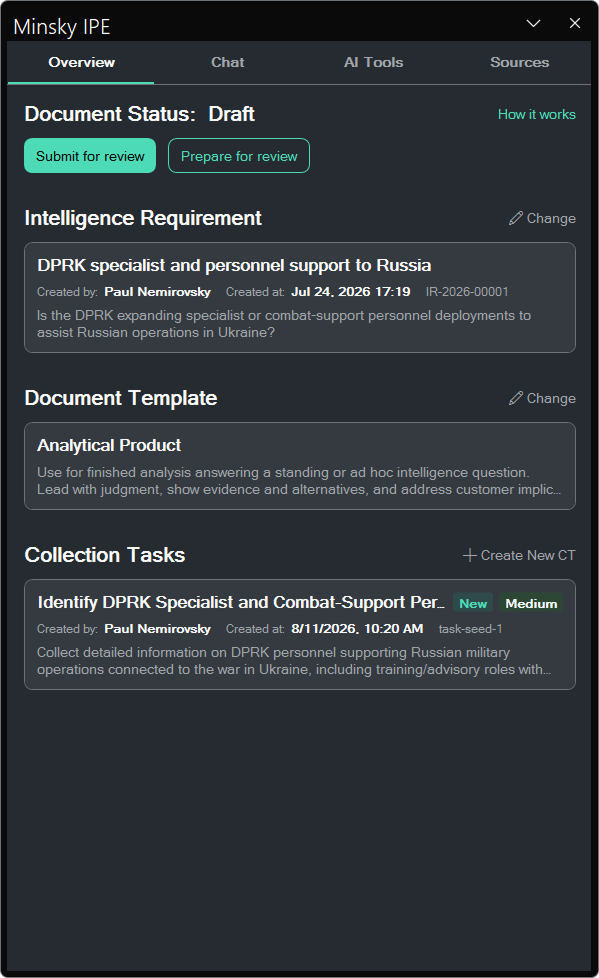
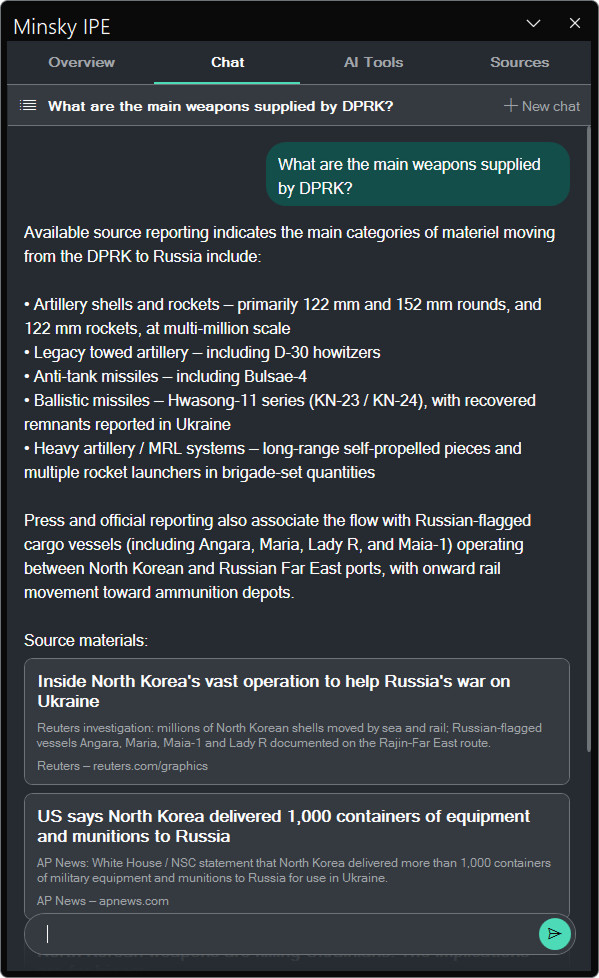
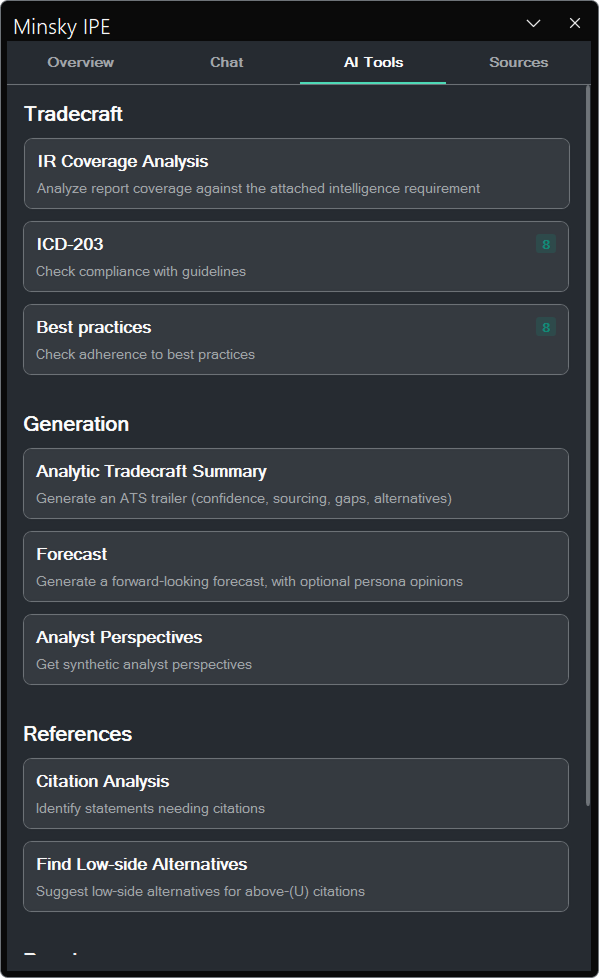
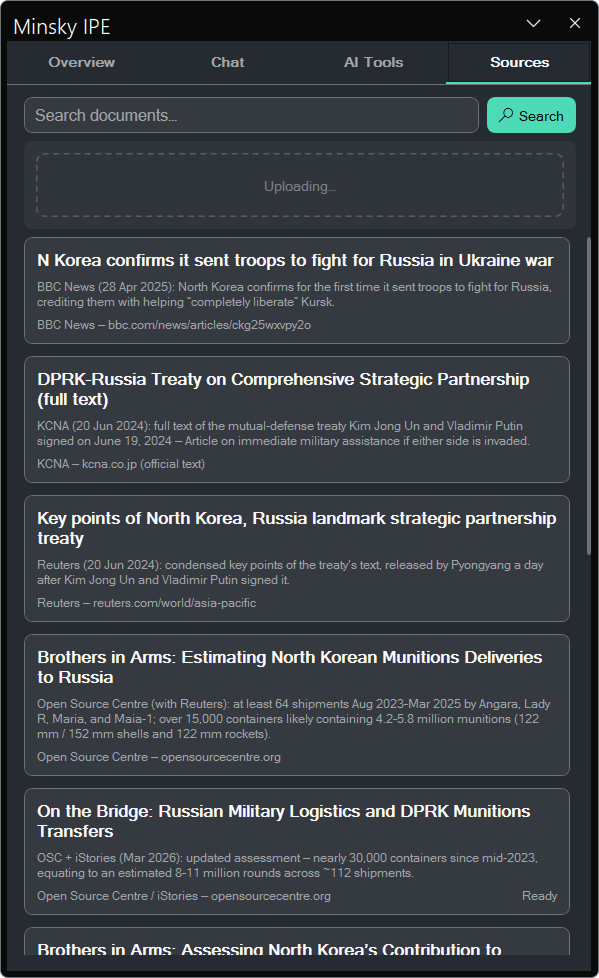
Stub description for this section. Replace with final copy that frames the solution and the product image below.
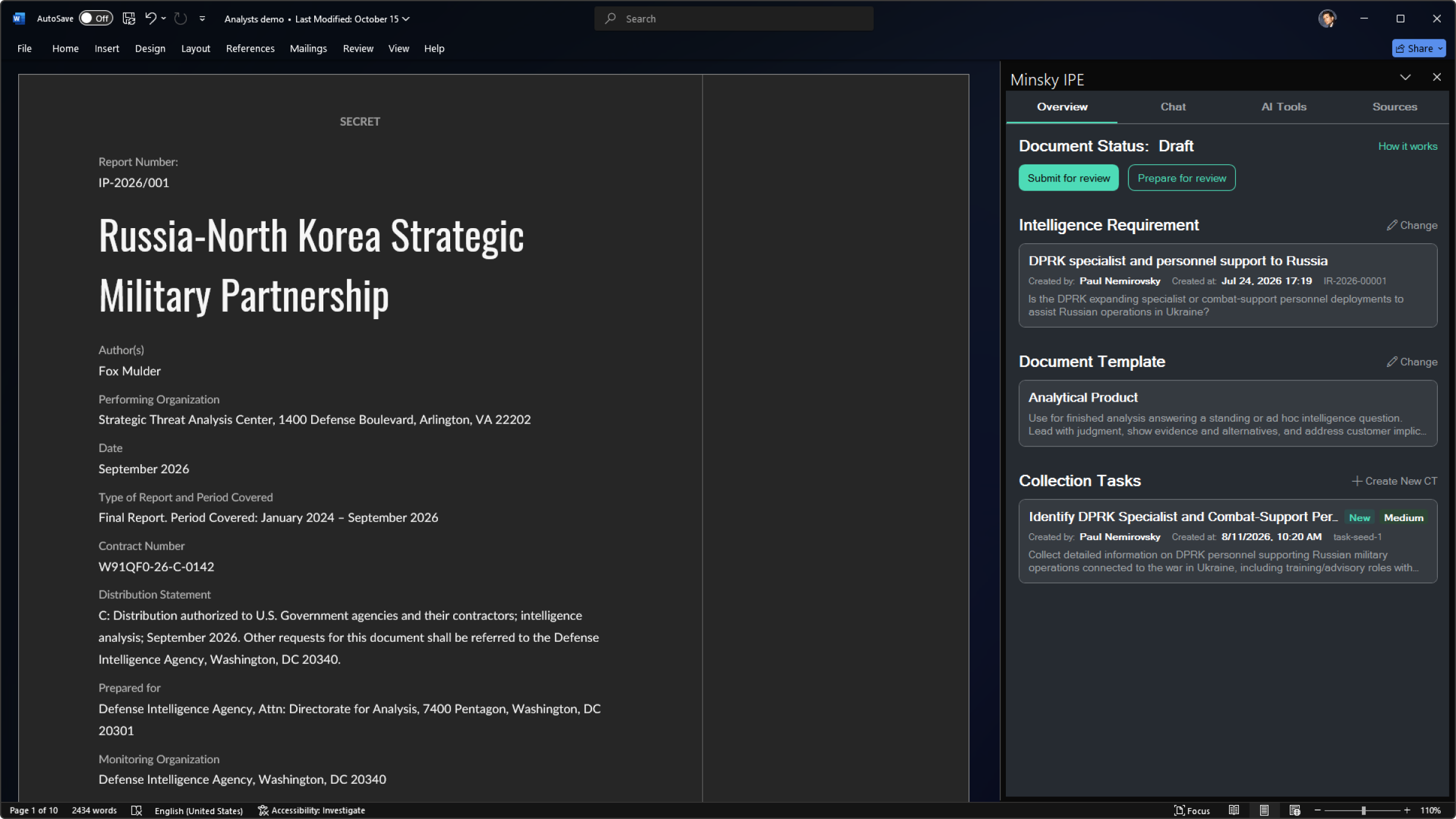
Feature one
Stub description for feature one. Replace with copy that explains this part of the solution.
- Stub bullet A
- Stub bullet B
- Stub bullet C
15